 이 누리집은 대한민국 공식 전자정부 누리집입니다.
go.kr 주소를 사용하는 누리집은 대한민국 정부기관이 관리하는 누리집입니다.
이 밖에 or.kr 또는 .kr등 다른 도메인 주소를 사용하고 있다면 아래 URL에서 도메인 주소를 확인해 보세요.










- 공연
- 교육
- 이용안내
- 소식 · 참여
- 극장소개
-
빠른예매
-
추천공연
-
2026-2027 국립극장 레퍼토리시즌
- 국립무용단<2026 안무가 프로젝트>
- 국립창극단 <2026 창극 작가 프로젝트 시연회>
- 국립창극단 <완창판소리> 11월
- 서울예술단 창작가무극 <백범>
- 국립국악관현악단 관현악시리즈Ⅱ <2026 디스커버리>
- 국립창극단 <오이디푸스>
- 국립극장 마당놀이 <춘풍처도 온다>
-
양방언 솔로 데뷔 30주년 기념 공연
- 국립심포니콘서트오케스트라 <베토벤 교향곡 9번 '합창'>
- 2026 <정오의 음악회> 12월
- 국립합창단 <한국 가곡의 모든 것>
- 국립국악관현악단 <2026 윈터 콘서트>
- 국립극장 기획 <다정히 세상을 누리면>
- 국립무용단 <향연>
- 국립창극단 <2026 송년판소리-소리정담>
- 국립창극단 <2026 송년음악회-어질더질>
- 2027 국립오페라단 <신년음악회>
- 트위스트 1971 공연제작소 <리턴 투 햄릿>
- 국립국악관현악단 <2027 신년 음악회>
- 국립무용단 <2027 축제>
- 2027 <정오의 음악회> 3월
- 극공작소 마방진 <리어왕외전>
- 국립창극단 <절창 Ⅶ>
- 국립국악관현악단 관현악시리즈III <음악 오디세이: 거상>
- 국립창극단 <완창판소리> 3월
- 국립무용단 <파이브 바이브>
- 국립무용단 <미인>
- 2027 <정오의 음악회> 4월
- 국립극장 기획 <2027 함께, 봄>
- 국립창극단 <리어>
- 국립국악관현악단 어린이 음악회 <신나락 만나락>
- 국립극단 <파우스트>
- 국립창극단 <완창판소리> 4월
- (주)문컴퍼니 <노인과 바다>
- 국립합창단 <오월의 화음>
- 2027 <정오의 음악회> 5월
- 국립창극단 <완창판소리> 5월
- NT Live <진지함의 중요성>
- NT Live <위험한 관계>
- 국립국악관현악단 <애주가>
- 국립무용단 <겹>
- 국립극장 기획 <카운트 나인>
- 국립국악관현악단 관현악시리즈IV <신보(新譜)>
- 국립창극단 <완창판소리> 6월
- 국립창극단 <춘향>
- [패키지] 26-27 프리패키지 R - I
- [패키지] 26-27 프리패키지 S - I
- [패키지] [매진] 26-27 완창판소리 I
- [패키지] [매진] 26-27 정오의 음악회 I
- [패키지] 26-27 프리패키지 S - Ⅱ
- [패키지] 26-27 프리패키지 R - Ⅱ
- [패키지] 26-27 정오의 음악회 Ⅱ
- [패키지] 26-27 완창판소리 Ⅱ
- [패키지] 26-27 NDCK 패키지
- [패키지] 26-27 NT Live Ⅱ
-
추천공연
2025년 6월호 Vol. 419
목차 열기태국 전통 가면극 <콘>
살라 찰럼끄룽 왕립극장의 살아 숨 쉬는 유산
태국의 심장부이자 역사의 중심지인 랏따나꼬신 올드타운에서 펼쳐지는 <콘>은
고풍스러운 왕실 예술과 현대적 감각이 조화를 이루며 매년 수많은 관객을 매료한다.
<Khon> Masked Dance Drama in Thailand
Living Heritage of Sala Chalermkrung Royal Theatre
Taking place in the old town of Rattanakosin, the center of the country and its history, Khon fascinates innumerable visitors every year through its harmony of traditional royal art and contemporary sensibility.
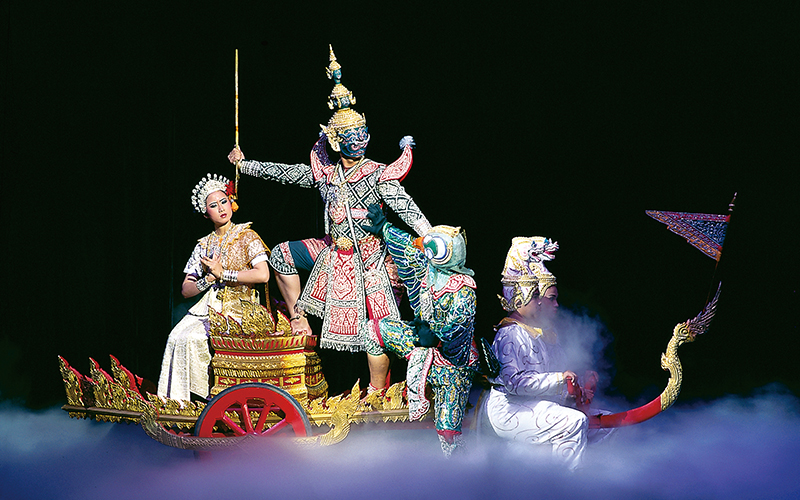
방콕을 여행해 본 사람이라면 누구나 수완나품 국제공항에서 마주치는 거대한 야차상夜叉像을 기억할 것이다. 녹색 피부에 날카로운 눈빛을 지닌 이 인상적 존재는 단순한 장식이 아니라, 태국 신화의 세계로 향하는 첫 관문이자 강렬한 인상을 남기는 문화적 상징이다. 야차상은 방콕의 사원과 왕궁 입구에서도 쉽게 볼 수 있는데, 이는 태국의 깊고도 다채로운 정신세계를 마주하게 되는 시작점이 된다.
공항에서 시작된 호기심은 도심 속 살라 찰럼끄룽 왕립극장의 <콘> 공연에서 완성된다. 이곳에서 방문객들은 야차를 통해 태국인들의 세계관을 온전히 이해하게 된다. 왕립극장의 찬란한 무대 위에서 야차는 단순한 신화적 생명체를 넘어 태국 문화의 정수를 담은 상징으로 거듭난다. 때로는 영웅의 충직한 전사로, 때로는 사악한 악마로 변신하며 선과 악의 우주적 대결을 생생하게 그려 낸다.
방콕 왕궁 인근에 위치한 살라 찰럼끄룽 왕립극장은 1933년에 문을 연 아시아 최초의 현대식 극장이다. 라마 7세 국왕의 후원 아래 건립된 이 극장은 오늘날 태국 전통 공연의 맥을 잇고 발전시키는 중요한 문화공간으로 자리매김했다. 한때 국제 영화 상영관으로 사용되기도 했던 이 공간은 대형 사설 극장이 생겨난 1980년대 이후 전통 공연예술의 전당으로 거듭났으며, 2007년 시리킷 왕비가 주도한 전통예술 부흥 프로젝트와 함께 리노베이션을 거쳐 최신 설비를 갖춘 900석 규모의 공연장으로 재탄생했다.
공연장 내부는 태국 전통 건축양식과 현대적 편의시설이 절묘하게 조화를 이루고 있다. 붉은색과 금색을 주조로 한 화려한 장식은 태국 왕실의 권위를 상징하며, 오랜 역사에도 불구하고 음향과 조명 설비는 최신식으로 정비되어 있어 최적의 공연 환경을 제공한다. 로비에는 공연에 쓰이는 가면과 의상에 관한 소규모 전시 공간이 마련되어 있어, 공연 관람 전 태국 전통극에 대한 이해를 높이는 기회를 제공한다.
<콘>은 태국의 국가 서사시 「라마키안」을 화려한 가면과 춤으로 풀어낸 작품이다. 공연은 시바 신의 아내 프라 우마의 신성한 정원에서 시작된다. 힘과 장난기로 유명한 원숭이 왕 하누만은 이 금지된 정원에 몰래 들어간다. 탐스러운 과일의 유혹에 이끌린 그는 허락 없이 과일을 따 먹는다. 이에 분노한 프라 우마는 하누만의 힘을 빼앗는 저주를 내리고, 오직 아유타야의 공정한 왕 프라람만이 그의 몸을 쓰다듬어 이 저주를 풀 수 있다고 선언한다.
저주로 인해 약해진 하누만은 프라람을 찾아 긴 여정을 떠난다. 그는 프라람이 악마 토사칸에게 납치된 아내 낭시다를 구하기 위해 랑카라는 도시로 향하고 있다는 소식을 듣는다. 깊은 숲속에서 프라람을 마주치게 된 하누만은 그에게 무릎을 꿇고 저주를 풀어 달라고 호소한다. 프라람은 하누만의 저주를 풀어 주고, 하누만은 즉시 원래의 막강한 힘을 되찾는다. 하누만이 자신의 부하 원숭이 군대를 소집해 프라람의 명령에 따를 것을 약속하자, 프라람은 그를 자신의 가장 믿음직한 장군으로 임명한다.
프라람은 하누만과 동맹자 수그리바에게 군대를 이끌고 바다를 건너 랑카로 향할 다리를 건설하라고 명령한다. 하누만은 부하들과 함께 거대한 바위를 옮겨 다리를 만들기 시작하지만, 바다의 수호자 수판 마차 여왕과 그녀의 바다 요정들이 침입자들을 방해한다. 하누만은 수판 마차와 치열한 대결을 벌여 자신의 힘과 지략으로 마침내 그녀를 항복시킨다. 패배한 바다 요정들은 이후 다리 건설을 돕게 된다.
다리가 완성되자 프라람은 랑카로 진군한다. 한편 토사칸은 군대를 소집해 프라람의 침공에 맞선다. 이 전투는 낭시다를 구하기 위한 최후의 대결로, 프라람과 토사칸이 각자의 군대를 이끌고 벌이는 장대한 싸움이다. 공연은 이 전투를 화려한 가면 춤과 역동적인 무대 연출로 표현하며, 선과 악의 갈등을 극적으로 보여 준다.
If you have been to Bangkok, you would probably remember the huge Yaksha statue at Suvarnabhumi Airport. This imposing statue with green skin and sharp eyes isn’t just a decoration but a cultural symbol; it is the first gateway to Thai mythology, impressing you powerfully. You can also see this statue easily at the entrance of the temples and the Grand Palace in Bangkok. It serves as the starting point of entering Thailand’s profound and colorful spiritual world.
The statue at the airport arouses your curiosity which is finally fulfilled during the Khon performance at Sala Chalermkrung Royal Theatre at the heart of the city. It is an occasion to fully understand Thai people’s world view through Yaksha. On the Royal Theatre’s splendid stage, Yaksha goes beyond just being a mythological character to be born again as a symbol embodying the essence of Thai culture. Yaksha is sometimes a loyal, heroic warrior and sometimes, a wicked devil. In this way, it vividly describes the cosmic duel between good and evil.
Located in the vicinity of the Grand Palace, Sala Chalermkrung Royal Theatre is Asia’s first modern theater which was opened in 1933. The theater’s founding was sponsored by Rama VII and it has become an important cultural venue preserving and developing Thailand’s traditional performing arts. It was once used as an international film theater and since the 1980s when large, privately owned theaters began to open in the country, it has been transformed into a venue of the traditional performing arts. During the traditional arts revival project led by Queen Sirikit in 2007, the theater was renovated to be born again as a performance venue with the newest equipment and 900 seats.
The inside of the theater shows delicate harmony of the traditional Thai architectural style and modern facilities. Colorful decorations, which are mostly red and gold, symbolize the authority of the Thai royal family. Despite its long history, the theater has the newest sound and lighting equipment, offering an optimum environment for performances. At the lobby, there is a small exhibition space focused on masks and costumes used for Khon, giving you a better understanding of the traditional Thai drama before you see the performance.
Khon unfolds Thailand’s national epic Ramakien with colorful masks and dances. The performance starts in the sacred garden of Phra Uma, Shiva’s wife. Hanuman, the monkey god well known for his power and mischievousness, goes inside this forbidden garden secretly. Captivated by the fully ripe fruit he finds there, he eats it without permission. Enraged, Phra Uma puts a curse on Hanuman to take away his power. And she declares that only Phra Ram (Rama), the just king of Ayutthaya, can lift the curse by touching Hanuman’s body.
Weakened by the curse, Hanuman sets out on a long journey to look for Phra Ram. He then hears that Phra Ram is heading to a city called Lanka in order to rescue his wife Nang Sida kidnapped by the devil Thotsakan. Hanuman finally runs into Phra Ram deep inside a forest and kneeling down, he begs the king to lift his curse. Phra Ram does so and Hanuman regains his great power immediately. As Hanuman summons his monkey troops and promises to follow Phra Ram’s orders, Phra Ram appoints him as his most trustworthy general.
Phra Ram orders Hanuman and his ally Sugreeva to lead their army, cross the ocean and build a bridge to Lanka. Hanuman then starts building the bridge by piling huge rocks with his servants. But Queen Supan Matcha, guardian of the sea, and her sea nymphs disrupt the intruders’ work. Hanuman then engages in a fierce fight with Supan Matcha. And using his power and resourcefulness, he finally makes her surrender. Defeated, the sea nymphs end up giving a helping hand to the bridge construction work.
Once the bridge is completed, Phra Ram marches to Lanka. In parallel, Thotsakan mobilizes his troops to stand against Phra Ram’s attack. This is Phra Ram’s ultimate battle to rescue Nang Sida. For this large-scale battle, each of Phra Ram and Thotsakan leads his troops. The Khon performance depicts their duel with colorful mask dances and dynamic mise en scène, illustrating the conflict between good and evil in a dramatic way.
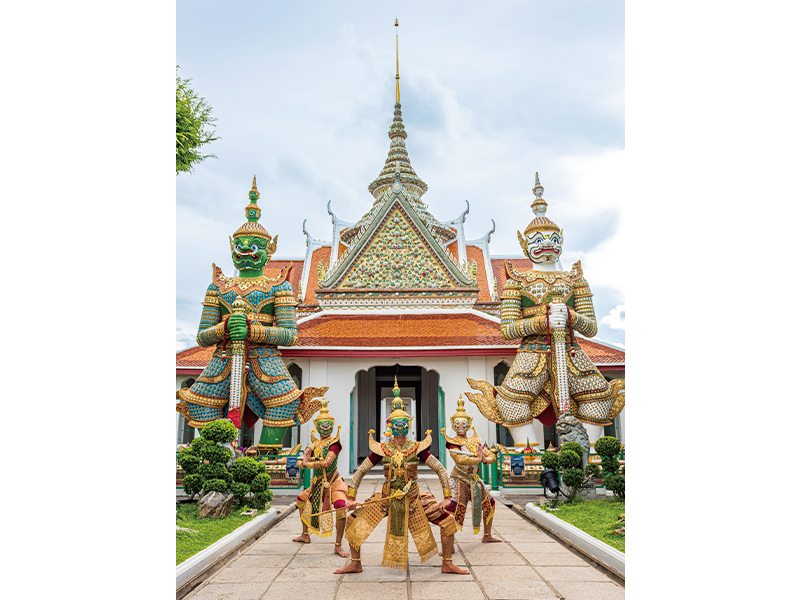
무대에 오른 배우들의 모습은 그 자체로 살아 있는 예술품이다. 악마 토사칸과 원숭이 하누만, 수그리바 등은 화려한 색채와 정교한 디테일이 돋보이는 가면을 착용하고 등장한다. 하누만의 재빠른 동작과 유연한 몸짓은 원숭이의 특징을 생생히 재현하며, 토사칸의 위압적 존재감은 가면의 위력을 한층 배가한다. 프라람과 낭시다 역할은 가면 대신 정교한 분장과 왕실 복장을 본뜬 고급 직물 의상으로 우아함을 더한다. 금색 장신구와 화려한 머리 장식은 태국 전통 의상 제작 기술의 정수를 보여 주며, 섬세한 손동작은 이야기를 시각적으로 전달한다.
무대 한쪽에서는 피팟* 오케스트라가 전통 타악기와 현악기를 연주하며 극의 분위기를 고조시킨다. 전투 장면에서 울려 퍼지는 강렬한 타악기 소리와 감성적 장면에서 흐르는 서정적 선율의 대비가 두드러진다. 배우들이 가면을 쓰고 있어 대사를 할 수 없기 때문에 내레이터와 가수들이 이야기를 전달하고 인물의 감정을 노래로 표현한다.
전통적으로 왕실 전용 예술이었던 <콘>은 20세기 중반 이후 대중화되었으며, 살라 찰럼끄룽 왕립극장은 이를 현대적으로 재해석하고 있다.
「라마키안」은 인도의 ‘라마야나’에서 유래된 태국의 대표 서사문학으로, 힌두문화 기반의 이야기가 불교문화 속에서 재탄생했다. 차크리 왕조의 라마 1세는 이 문화유산의 부활에 기여했으며, 특히 라마 6세 시기에 가면극 <콘>이 크게 발전했다. 라마 6세는 서양 문화의 유입에 맞서 태국 고유문화를 지키기 위해 이 가면극을 발전시켰으며, 내부의 정치적 위기 속에서 왕실에 대한 국민의 지지를 얻기 위한 수단으로도 활용했다.
오늘날 <콘> 공연은 전통 안무를 충실히 재현하면서도 현대적 조명과 무대 기술을 접목해 전통예술에 새로운 생동감을 불어넣고 있다. 화려한 가면, 우아한 춤, 그리고 태국 서사시의 깊은 이야기가 어우러진 이 공연은 태국을 찾는 이들에게 잊지 못할 예술적 경험을 선사한다.
태국인들에게 <콘>은 단순한 공연예술이 아닌 자국의 정체성과 역사를 담고 있는 살아 있는 문화유산이며, 외국인 관객에게는 태국 문화의 깊이와 아름다움을 경험하는 특별한 기회다.
젊은 배우들이 태국 예술대학에서 <콘>을 전공하며 이 전통을 이어가고 있다는 점도 주목할 만하다. 태국 정부와 왕실이 <콘>을 보존하고 발전시키기 위해 기울이는 노력은 한국의 전통예술 지원 정책에도 시사점을 준다. 2018년 유네스코 무형문화유산으로 등재된 <콘>은 현대화의 물결 속에서도 고유의 가치를 인정받으며, 새로운 세대로 계승되고 있다.
The performers on stage are literally “living artworks.” The devil Thotsakan, the monkey god Hanuman and Sugreeva are wearing masks highlighting vivid colors and sophisticated details. Hanuman’s agility and flexibility clearly visualize a monkey’s characteristics while Thotsakan’s overwhelming existence adds to the powerfulness of the mask. Meanwhile, Phra Ram and Nang Sida bring elegance to the performance with their delicate makeup and costume of high-end fabric that would be worn by the royal family, instead of masks. Their gold ornaments and colorful hair accessories show the essence of Thailand’s artisanship for making traditional clothing. And their subtle hand movements tell the story visually.
In a corner, a Piphat* orchestra plays traditional percussion and string instruments, kindling the atmosphere. In particular, it is to take note of the contrast between the powerful percussion beats in the battle scene and the lyrical tunes in emotional scenes. The performers cannot speak because they are wearing masks. So the narrators and singers either tell the story or sing how the characters feel.
Traditionally, Khon was performed only for the royal family. But it has been popularized since the mid-20th century and Sala Chalermkrung Royal Theatre presents its contemporary reinterpretations.
Ramakien is Thailand’s representative epic literature which originated from India’s Ramayana. The story based on Hindu culture was made anew in Buddhist culture. Rama I of the Chakri Dynasty contributed to the revival of this cultural heritage. In particular, the masked dance drama Khon greatly developed during the reign of Rama VI who worked on its development in order to protect Thailand’s own culture from Western culture coming in. Rama VI also used the art form as a means to win citizens’ support for the royal family amid the country’s political crisis.
Today’s Khon performance is true to its traditional choreography while also adding contemporary lighting and stage technology, thus breathing a new vitality into the traditional art form. With its colorful masks, graceful dances and Thai epic deep inside it, the performance offers visitors to Thailand an unforgettable artistic experience.
To Thai people, Khon isn’t just a form of the performing arts; it is living cultural heritage which reflects their country’s identity and history. And to foreign visitors, it is a special opportunity to experience the depth and beauty of Thai culture. What is also notable is the fact that young performers study Khon at the country’s arts universities to continue the tradition. And the effort made by the Thai government and royal family to preserve and develop Khon is also something to note for Korea’s policy supporting the traditional arts. Joining the Representative List of the Intangible Cultural Heritage of Humanity in 2018, Khon is being passed on to new generations, making its own value recognized despite the waves of modernization.
세계 일주의 꿈을 품고 가족과 26개국 45개 도시를 여행했다. 2019년 한 달 살기로 치앙마이의 매력에 빠진 것을 계기로, 이후 온 가족이 이주해 정착했다. 한국에서 관광·문화콘텐츠 전공으로 박사과정을 수료하고, 현재 콘텐츠 마케터로 일하고 있다. 태국 치앙마이대학교에서 태국어와 태국 문화를 공부했다. 태국의 생활 정보 및 문화, 사업 이야기 등을 전하는 ‘치앙마이라이프’ 유튜브 채널을 운영하고 있다.
Dreaming of a world tour, Rio traveled to 45 cities in 26 countries with his family. Captivated by Chiang Mai after a month-long stay in the city in 2019, he and his family moved in and settled down there. He completed a doctorate course in tourism and cultural content in Korea and he currently works as a content marketer. He also studied the Thai language and culture at Chiang Mai University in Thailand. His YouTube channel called “Chiang Mai Life” shares daily life, culture and business in Thailand.
Photo by.TAT(Tourism Authority of Thailand)
* 피팟(Piphat, วงปี่พาทย์) : 태국 중부에서 발달한 타악기를 중심으로 한 전통 앙상블
* Piphat (วงปี่พาทย์) : a traditional ensemble focused on percussion which developed in central Thailand.
- 바위 아래 그윽한 꽃
- 불온한 욕망, 그 불편한 진실
- 어디에도 없지만, 우리 안에 있는 존재
- 순하고 부드럽게 함께 사는 세상의 꿈
- 한국 춤의 시간을 펼치는 맨즈 스테이지
- 요상한 민요 나라로의 초대
- 같은 음악, 다른 관현악
- 소리를 짓다, 삶을 읊다
- 엄마의 시선으로, 딸의 눈높이로
- 판소리의 동시대성을 보여 주다
- 국립무용단 정길만
- 머물고 싶은 순간, ‘한 번 더!’
- 살라 찰럼끄룽 왕립극장의 살아 숨 쉬는 유산
- 사색과 생명, 예술을 잇는 초여름의 길
- 한국무용에 ‘나’를 더하다
- 공연예술은 어떻게 시대를 이야기하는가
- 우리 무용의 정수
- 국립극장 소식

우) 04621 서울특별시 중구 장충단로 59 (장충동 2가, 국립극장)
/ 전화번호 :
☎02)2280-4114
국립중앙극장 / 사업자등록번호 : 203-83-00465
CopyRight ⓒ 2025 National Theater of Korea. All rights reserved.
정산대행사 : (주)컬처닷컴 대표자명 : 김기홍 사업자등록번호 : 120-87-53160 통신판매업신고번호 : 2019-서울서초-3322
우)06719 서울시 서초구 반포대로 10 신원빌딩 7층 FAX : 02)544-0966 Mail : webmaster@cnpart.com